
Privacy policy
Introduction and overview
We have drawn up this privacy policy (version 28.01.2023-122398608) in order to provide you with information in accordance with the requirements of the General Data Protection Regulation (EU) 2016/679 and applicable national laws, which personal data (data for short) we as the controller - and the processors (e.g. providers) commissioned by us - process, will process in the future and what lawful options you have. The terms used are to be understood as gender-neutral.
In short: We provide you with comprehensive information about data that we process about you.
Data protection declarations usually sound very technical and use legal jargon. This privacy policy, on the other hand, is intended to describe the most important things to you as simply and transparently as possible. As far as it is conducive to transparency, technical terms are terms are explained in a reader-friendly way, links to further information are provided and graphics are used. We thus provide information in clear and simple language that we only process personal data as part of our business activities if there is a corresponding legal basis. This is certainly not possible by providing explanations that are as concise, unclear and legally technical as possible, as is often standard on the Internet when it comes to data protection. I hope you find the following explanations interesting and informative and perhaps there is one or two pieces of information that you did not yet know.
If you still have any questions, we would ask you to contact the responsible body named below or in the legal notice, follow the links provided and look at further information on third-party websites. Our contact details can of course also be found in the legal notice.
Area of application
This privacy policy applies to all personal data processed by us in the company and to all personal data processed by companies commissioned by us (processors). By personal data, we mean information within the meaning of Art. 4 No. 1 GDPR, such as a person's name, email address and postal address. The processing of personal data ensures that we can offer and bill our services and products, whether online or offline. The scope of this privacy policy includes
- all online presences (websites, online stores) that we operate
- Social media presence and e-mail communication
- Mobile apps for smartphones and other devices
In short: The privacy policy applies to all areas in which personal data is processed in the company in a structured manner via the aforementioned channels. If we enter into legal relationships with you outside of these channels, we will inform you separately if necessary.
Legal basis
In the following privacy policy, we provide you with transparent information on the legal principles and regulations, i.e. the legal bases of the General Data Protection Regulation, which enable us to process personal data.
As far as EU law is concerned, we refer to REGULATION (EU) 2016/679 OF THE EUROPEAN PARLIAMENT AND OF THE COUNCIL of April 27, 2016. You can of course access this EU General Data Protection Regulation online on EUR-Lex, the gateway to EU law, at https://eur-lex.europa.eu/legal-content/DE/ALL/?uri=celex%3A32016R0679 .
We only process your data if at least one of the following conditions applies:
- Consent (Article 6(1)(a) GDPR): You have given us your consent to process data for a specific purpose. An example would be the storage of the data you entered in a contact form.
- Contract (Article 6(1)(b) GDPR): In order to fulfill a contract or pre-contractual obligations with you, we process your data. For example, if we conclude a purchase contract with you, we need personal information in advance.
- Legal obligation (Article 6(1)(c) GDPR): If we are subject to a legal obligation, we process your data. For example, we are legally obliged to keep invoices for accounting purposes. These usually contain personal data.
- Legitimate interests (Article 6(1)(f) GDPR): In the case of legitimate interests that do not restrict your fundamental rights, we reserve the right to process personal data. For example, we need to process certain data in order to operate our website securely and efficiently. This processing is therefore a legitimate interest.
Other conditions such as recording in the public interest, the exercise of official authority and the protection of vital interests do not generally apply to us. If such a legal basis is relevant, it will be indicated at the appropriate point.
In addition to the EU regulation, national laws also apply:
- In Austria, this is the Federal Act on the Protection of Natural Persons with regard to the Processing of PersonalData (Data Protection Act), or DSG for short.
- In Germany, the Federal Data Protection Act( BDSG) applies.
If other regional or national laws apply, we will inform you of this in the following sections.
Contact details of the person responsible
If you have any questions about data protection or the processing of personal data, you will find the contact details of the person or body responsible below:
Anita Pur
Lindingerstrasse 3
4910 Ried im Innkreis
AUSTRIA
E-Mail: anita@snoezi.at
Phone:00436644361716
Imprint: https://www.snoezi.com/impressum/
Storage duration
It is a general criterion for us that we only store personal data for as long as is absolutely necessary for the provision of our services and products. This means that we delete personal data as soon as the reason for the data processing no longer exists. In some cases, we are legally obliged to store certain data even after the original purpose has ceased to exist, for example for accounting purposes.
If you wish your data to be deleted or revoke your consent to data processing, the data will be deleted as quickly as possible and insofar as there is no obligation to store it.
We will inform you below about the specific duration of the respective data processing if we have further information on this.
Rights under the General Data Protection Regulation
In accordance with Articles 13, 14 GDPR, we inform you of the following rights to which you are entitled in order to ensure fair and transparent processing of data:
- According to Article 15 GDPR, you have a right to information as to whether we process your data. If this is the case, you have the right to receive a copy of the data and the following information:
- the purpose for which we carry out the processing;
- the categories, i.e. the types of data that are processed;
- who receives this data and, if the data is transferred to third countries, how security can be guaranteed;
- how long the data will be stored;
- the existence of the right to rectification, erasure or restriction of processing and the right to object to processing;
- that you can lodge a complaint with a supervisory authority (links to these authorities can be found below);
- the origin of the data if we have not collected it from you;
- whether profiling is carried out, i.e. whether data is automatically analyzed in order to create a personal profile of you.
- According to Article 16 GDPR, you have a right to rectification of data, which means that we must correct data if you find errors.
- According to Article 17 GDPR, you have the right to erasure ("right to be forgotten"), which specifically means that you may request the erasure of your data.
- According to Article 18 GDPR, you have the right to restriction of processing, which means that we may only store the data but no longer use it.
- According to Article 20 GDPR, you have the right to data portability, which means that we will provide you with your data in a commonly used format upon request.
- According to Article 21 GDPR, you have the right to object, which will result in a change in the processing after enforcement.
- If the processing of your data is based on Article 6(1)(e) (public interest, exercise of official authority) or Article 6(1)(f) (legitimate interest), you can object to the processing. We will then check as quickly as possible whether we can legally comply with this objection.
- If data is used for direct marketing purposes, you can object to this type of data processing at any time. We may then no longer use your data for direct marketing.
- If data is used for profiling purposes, you can object to this type of data processing at any time. We may then no longer use your data for profiling.
- Under Article 22 GDPR, you may have the right not to be subject to a decision based solely on automated processing (e.g. profiling).
- According to Article 77 GDPR, you have the right to lodge a complaint. This means that you can lodge a complaint with the data protection authority at any time if you believe that the processing of personal data violates the GDPR.
In short: You have rights - do not hesitate to contact the responsible body listed above!
If you believe that the processing of your data violates data protection law or that your data protection rights have been violated in any other way, you can lodge a complaint with the supervisory authority. For Austria, this is the data protection authority, whose website you can find at https://www.dsb.gv.at/ . In Germany, there is a data protection officer for each federal state. For more information, you can contact the Federal Commissioner for Data Protection and Freedom of Information (BfDI) for further information. The following local data protection authority is responsible for our company:
Austria Data Protection Authority
Head: Dr. Andrea Jelinek
Address: Barichgasse 40-42, 1030 Vienna
Telephone no.: +43 1 52 152-0
E-mail address: dsb@dsb.gv.at
Website: https://www.dsb.gv.at/
Security of data processing
In order to protect personal data, we have implemented both technical and organizational measures. Where possible, we encrypt or pseudonymize personal data. In this way, we make it as difficult as possible for third parties to infer personal information from our data.
Art. 25 GDPR speaks here of "data protection by design and by default" and thus means that both software (e.g. forms) and hardware (e.g. access to the server room) should always be designed with security in mind and appropriate measures should be taken. If necessary, we will discuss specific measures below.
TLS encryption with https
TLS, encryption and https sound very technical - and they are. We use HTTPS (the Hypertext Transfer Protocol Secure stands for "secure hypertext transfer protocol") to transmit data tap-proof on the Internet.
This means that the complete transmission of all data from your browser to our web server is secure - nobody can "listen in".
We have thus introduced an additional layer of security and fulfill data protection through technology design (Article 25(1) GDPR). By using TLS (Transport Layer Security), an encryption protocol for secure data transmission on the Internet, we can ensure the protection of confidential data.
You can recognize the use of this data transmission protection by the small lock symbol  at the top left of the browser, to the left of the Internet address (e.g. examplepage.com) and the use of the https scheme (instead of http) as part of our Internet address.
If you want to know more about encryption, we recommend a Google search for "Hypertext Transfer Protocol Secure wiki" to get good links to further information.
Communication
| Communication summary 👥 Data subjects: Anyone who communicates with us by telephone, email or online form 📓 Processed data: e.g. telephone number, name, email address, form data entered. You can find more details on this in the respective contact type used 🤝 Purpose: Processing of communication with customers, business partners, etc. 📅 Storage period: Duration of the business case and the statutory provisions ⚖️ Legal bases: Art. 6 para. 1 lit. a GDPR (consent), Art. 6 para. 1 lit. b GDPR (contract), Art. 6 para. 1 lit. f GDPR (legitimate interests) |
If you contact us and communicate with us by telephone, e-mail or online form, personal data may be processed.
The data is processed for the handling and processing of your question and the associated business transaction. The data will be stored for as long as required by law.
Affected persons
All those who seek contact with us via the communication channels provided by us are affected by the aforementioned processes.
Telephone
When you call us, the call data is stored pseudonymously on the respective end device and with the telecommunications provider used. In addition, data such as name and telephone number may subsequently be sent by e-mail and stored for the purpose of responding to inquiries. The data will be deleted as soon as the business case has been completed and legal requirements permit.
If you communicate with us by email, data may be stored on the respective end device (computer, laptop, smartphone, etc.) and data may be stored on the email server. The data will be deleted as soon as the business transaction has been completed and legal requirements permit.
Online forms
If you communicate with us using an online form, data is stored on our web server and may be forwarded to one of our e-mail addresses. The data will be deleted as soon as the business transaction has been completed and legal requirements permit.
Legal basis
The processing of the data is based on the following legal bases:
- Art. 6 para. 1 lit. a GDPR (consent): You give us your consent to store your data and to use it for purposes relating to the business transaction;
- Art. 6 para. 1 lit. b GDPR (contract): It is necessary for the performance of a contract with you or a processor, such as the telephone provider, or we need to process the data for pre-contractual activities, such as the preparation of an offer;
- Art. 6 para. 1 lit. f GDPR (legitimate interests): We want to handle customer inquiries and business communication in a professional manner. This requires certain technical facilities such as email programs, exchange servers and mobile network operators in order to be able to operate communication efficiently.
Data processing agreement (DPA)
In this section, we would like to explain what a data processing agreement is and why it is needed. Because the word "data processing agreement" is a bit of a mouthful, we will often only use the acronym DPA in this text. Like most companies, we do not work alone, but also use the services of other companies or individuals. By involving various companies or service providers, we may pass on personal data for processing. These partners then act as processors with whom we conclude a contract, the so-called data processing agreement (DPA). The most important thing for you to know is that the processing of your personal data takes place exclusively in accordance with our instructions and must be regulated by the DPA.
Who are processors?
As a company and website owner, we are responsible for all data that we process from you. In addition to controllers, there may also be so-called processors. This includes any company or person who processes personal data on our behalf. More precisely and according to the GDPR definition: any natural or legal person, public authority, agency or other body which processes personal data on our behalf is considered a processor. Processors can therefore be service providers such as hosting or cloud providers, payment or newsletter providers or large companies such as Google or Microsoft.
To make the terminology easier to understand, here is an overview of the three roles in the GDPR:
Data subject (you as a customer or interested party) → Controller (we as a company and client) → Processor (service provider such as web host or cloud provider)
Content of an order processing contract
As mentioned above, we have concluded a DPA with our partners who act as processors. This states above all that the processor processes the data to be processed exclusively in accordance with the GDPR. The contract must be concluded in writing, although the electronic conclusion of the contract is also considered "written" in this context. The processing of personal data only takes place on the basis of the contract. The contract must contain the following:
- Commitment to us as the responsible party
- Obligations and rights of the controller
- Categories of affected persons
- Type of personal data
- Nature and purpose of data processing
- Purpose and duration of data processing
- Place of data processing
Furthermore, the contract contains all obligations of the processor. The most important obligations are
- Ensure data security measures
- take possible technical and organizational measures to protect the rights of the data subject
- to maintain a data processing directory
- cooperate with the data protection supervisory authority at its request
- carry out a risk analysis in relation to the personal data received
- Sub-processors may only be commissioned with the written consent of the controller
You can find out what an AVV looks like in concrete terms at https://www.wko.at/service/wirtschaftsrecht-gewerberecht/eu-dsgvo-mustervertrag-auftragsverarbeitung.html for example. A sample contract is presented here.
Liability for links on this website
Our website contains links to other websites for whose content we are not responsible. We are not liable for linked websites, as we had and have no knowledge of illegal activities, we have not noticed any such illegal activities and we would remove links immediately if we became aware of any illegal activities.
If you notice any illegal links on our website, please contact us. You will find the contact details in the imprint.
Cookies
| Cookies Summary 👥 Data subject: Visitors to the website 🤝 Purpose: Depending on the cookie in question. You can find more details on this below or from the manufacturer of the software that sets the cookie. 📓 Processed data: Depending on the cookie used. You can find more details on this below or from the manufacturer of the software that sets the cookie. 📅 Storage duration: depends on the respective cookie, can vary from hours to years ⚖️ Legal basis: Art. 6 para. 1 lit. a GDPR (consent), Art. 6 para. 1 lit.f GDPR (legitimate interests) |
What are cookies?
Our website uses HTTP cookies to store user-specific data.
Below we explain what cookies are and why they are used so that you can better understand the following privacy policy.
Whenever you surf the internet, you use a browser. Well-known browsers include Chrome, Safari, Firefox, Internet Explorer and Microsoft Edge. Most websites store small text files in your browser. These files are called cookies.
One thing cannot be denied: Cookies are really useful little helpers. Almost all websites use cookies. More precisely, they are HTTP cookies, as there are also other cookies for other areas of application. HTTP cookies are small files that are stored on your computer by our website. These cookie files are automatically stored in the cookie folder, the "brain" of your browser, so to speak. A cookie consists of a name and a value. When defining a cookie, one or more attributes must also be specified.
Cookies store certain user data about you, such as language or personal page settings. When you visit our site again, your browser transmits the "user-related" information back to our site. Thanks to cookies, our website knows who you are and offers you the settings you are used to. In some browsers, each cookie has its own file; in others, such as Firefox, all cookies are stored in a single file.
The following graphic shows a possible interaction between a web browser such as Chrome and the web server. The web browser requests a website and receives a cookie back from the server, which the browser uses again as soon as another page is requested.
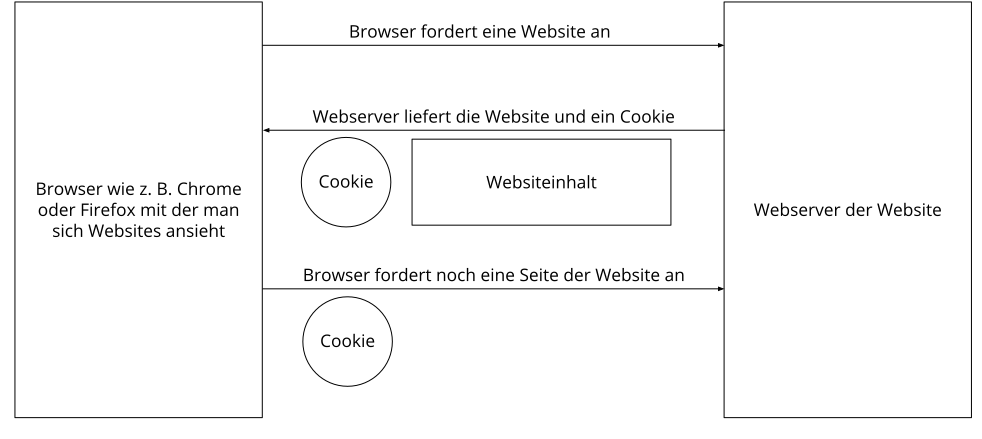
There are both first-party cookies and third-party cookies. First-party cookies are created directly by our website, third-party cookies are created by partner websites (e.g. Google Analytics). Each cookie must be evaluated individually, as each cookie stores different data. The expiry time of a cookie also varies from a few minutes to a few years. Cookies are not software programs and do not contain viruses, Trojans or other "malware". Cookies also cannot access information on your PC.
Cookie data can look like this, for example:
Name: _ga
Value: GA1.2.1326744211.152122398608-9
Purpose: Differentiation of website visitors
Expiry date: after 2 years
A browser should be able to support these minimum sizes:
- At least 4096 bytes per cookie
- At least 50 cookies per domain
- At least 3000 cookies in total
What types of cookies are there?
The question of which cookies we use in particular depends on the services used and is clarified in the following sections of the privacy policy. At this point, we would like to briefly explain the different types of HTTP cookies.
A distinction can be made between 4 types of cookies:
Essential cookies
These cookies are necessary to ensure basic functions of the website. For example, these cookies are needed when a user places a product in the shopping cart, then continues surfing on other pages and only goes to the checkout later. These cookies ensure that the shopping cart is not deleted even if the user closes their browser window.
Purposeful cookies
These cookies collect information about user behavior and whether the user receives any error messages. These cookies are also used to measure the loading time and the behavior of the website with different browsers.
Targeted cookies
These cookies ensure better user-friendliness. For example, entered locations, font sizes or form data are saved.
Advertising cookies
These cookies are also known as targeting cookies. They are used to deliver customized advertising to the user. This can be very practical, but also very annoying.
When you visit a website for the first time, you are usually asked which of these cookie types you would like to allow. And of course this decision is also stored in a cookie.
If you would like to know more about cookies and are not afraid of technical documentation, we recommend https://datatracker.ietf.org/doc/html/rfc6265, the Request for Comments of the Internet Engineering Task Force (IETF) called "HTTP State Management Mechanism".
Purpose of processing via cookies
The purpose ultimately depends on the cookie in question. You can find more details on this below or from the manufacturer of the software that sets the cookie.
What data is processed?
Cookies are little helpers for many different tasks. Unfortunately, it is not possible to generalize which data is stored in cookies, but we will inform you about the processed or stored data in the following privacy policy.
Storage duration of cookies
The storage period depends on the cookie in question and is specified below. Some cookies are deleted after less than an hour, others can remain stored on a computer for several years.
You can also influence the storage period yourself. You can delete all cookies manually at any time via your browser (see also "Right to object" below). Furthermore, cookies that are based on consent will be deleted at the latest after you withdraw your consent, whereby the legality of the storage until then remains unaffected.
Right to object - how can I delete cookies?
You decide how and whether you want to use cookies. Regardless of which service or website the cookies originate from, you always have the option of deleting, deactivating or only partially allowing cookies. For example, you can block third-party cookies but allow all other cookies.
If you want to find out which cookies have been stored in your browser, if you want to change or delete cookie settings, you can find this in your browser settings:
Chrome: Delete, activate and manage cookies in Chrome
Safari: Managing cookies and website data with Safari
Firefox: Delete cookies to remove data that websites have stored on your computer
Internet Explorer: Deleting and managing cookies
Microsoft Edge: Deleting and managing cookies
If you generally do not want to have cookies, you can set up your browser so that it always informs you when a cookie is to be set. You can then decide for each individual cookie whether or not to allow it. The procedure differs depending on the browser. It is best to search for the instructions in Google using the search term "delete cookies Chrome" or "deactivate cookies Chrome" in the case of a Chrome browser.
Legal basis
The so-called "Cookie Guidelines" have been in place since 2009. These state that the storage of cookies requires your consent (Article 6(1)(a) GDPR). However, there are still very different reactions to these directives within the EU countries. In Austria, however, this directive was implemented in Section 165 (3) of the Telecommunications Act (2021). In Germany, the cookie directives have not been implemented as national law. Instead, this directive was largely implemented in Section 15 (3) of the Telemedia Act (TMG).
For strictly necessary cookies, even if no consent has been given, there are legitimate interests (Article 6(1)(f) GDPR), which in most cases are of an economic nature. We want to provide visitors to the website with a pleasant user experience and certain cookies are often absolutely necessary for this.
If cookies that are not absolutely necessary are used, this will only take place with your consent. The legal basis in this respect is Art. 6 para. 1 lit. a GDPR.
In the following sections, you will be informed in more detail about the use of cookies if the software used uses cookies.
All texts are protected by copyright.
Source: Created with the Data Protection Generator Austria by AdSimple
Messenger & Communication Introduction
| Messenger & Communication Privacy Policy Summary 👥 Data subjects: Visitors to the website 🤝 Purpose: Contact requests and general communication between us and you 📓 Processed data: Data such as name, address, email address, telephone number, general content data, IP address if applicable You can find more details on this in the respective tools used. 📅 Storage period: depending on the messenger & communication functions used ⚖️ Legal basis: Art. 6 para. 1 lit. a GDPR (consent), Art. 6 para. 1 lit. f GDPR (legitimate interests), Art. 6 para. 1 sentence 1 lit. b. GDPR (contractual or pre-contractual obligations) |
What are messenger & communication functions?
We offer various options on our website (such as messenger and chat functions, online and contact forms, email, telephone) for communicating with us. Your data will also be processed and stored to the extent necessary to answer your request and our subsequent actions.
In addition to traditional means of communication such as email, contact forms and telephone, we also use chats and messengers. The most commonly used messenger function is currently WhatsApp, but there are of course many different providers that offer messenger functions specifically for websites. If content is end-to-end encrypted, this is indicated in the individual data protection texts or in the privacy policy of the respective provider. End-to-end encryption means that the content of a message itself is not visible to the provider. However, information about your device, location settings and other technical data can still be processed and stored.
Why do we use messenger & communication functions?
Communication options with you are of great importance to us. After all, we want to talk to you and answer all possible questions about our service in the best possible way. Well-functioning communication is an important part of our service. With the practical messenger & communication functions, you can choose the ones you prefer at any time. In exceptional cases, however, we may not be able to answer certain questions via chat or messenger. This is the case, for example, when it comes to internal contractual matters. In this case, we recommend other communication options such as e-mail or telephone.
As a rule, we assume that we remain responsible under data protection law, even if we use the services of a social media platform. However, the European Court of Justice has ruled that in certain cases the operator of the social media platform may be jointly responsible with us within the meaning of Art. 26 GDPR. If this is the case, we will point this out separately and work on the basis of an agreement to this effect. The essence of the agreement is set out below for the platform concerned.
Please note that when using our built-in elements, your data may also be processed outside the European Union, as many providers, such as Facebook Messenger or WhatsApp, are American companies. As a result, you may no longer be able to claim or enforce your rights in relation to your personal data as easily.
What data is processed?
Exactly which data is stored and processed depends on the respective provider of the messenger & communication functions. Basically, it is data such as name, address, telephone number, email address and content data such as all information that you enter in a contact form. In most cases, information about your device and IP address is also stored. Data that is collected via a messenger & communication function is also stored on the provider's servers.
If you want to know exactly what data is stored and processed by the respective providers and how you can object to data processing, you should carefully read the respective company's privacy policy.
How long is data stored?
How long the data is processed and stored depends primarily on the tools we use. You can find out more about the data processing of the individual tools below. The providers' privacy policies usually state exactly which data is stored and processed and for how long. In principle, personal data is only processed for as long as is necessary for the provision of our services. If data is stored in cookies, the storage period varies greatly. The data can be deleted immediately after leaving a website, but it can also remain stored for several years. You should therefore look at each individual cookie in detail if you want to know more about data storage. In most cases, you will also find informative information about the individual cookies in the data protection declarations of the individual providers.
Right of objection
You also have the right and the option to withdraw your consent to the use of cookies or third-party providers at any time. This works either via our cookie management tool or via other opt-out functions. For example, you can also prevent data collection by cookies by managing, deactivating or deleting cookies in your browser. For more information, please refer to the section on consent.
As cookies may be used for messenger & communication functions, we also recommend that you read our general privacy policy on cookies. To find out exactly which of your data is stored and processed, you should read the privacy policies of the respective tools.
Legal basis
If you have consented to your data being processed and stored by integrated messenger & communication functions, this consent is the legal basis for data processing (Art. 6 para. 1 lit. a GDPR). We process your request and manage your data in the context of contractual or pre-contractual relationships in order to fulfill our pre-contractual and contractual obligations or to answer inquiries. The basis for this is Art. 6 para. 1 sentence 1 lit. b. GDPR. In principle, your data will also be stored and processed on the basis of our legitimate interest (Art. 6 para. 1 lit. f GDPR) in fast and good communication with you or other customers and business partners if you have given your consent.
Facebook Messenger privacy policy
We use the instant messaging service Facebook Messenger on our website. The service provider is the American company Meta Platforms Inc. Meta Platforms Ireland Limited (4 Grand Canal Square, Grand Canal Harbour, Dublin 2, Ireland) is responsible for the European region.
What is Facebook Messenger?
Facebook Messenger is a chat messaging function developed by Facebook that allows you to send and receive text messages, voice and video calls, photos and other media files to other Facebook users.
When you use Facebook Messenger, your personal data is also processed on the Facebook servers. In addition to your phone number and chat messages, this also includes photos, videos, profile data, your address or your location.
Why do we use Facebook Messenger?
We want to stay in touch with you and the best way to do this is via messaging services such as Facebook Messenger. Firstly because the service works perfectly and secondly because Facebook is still one of the best-known social media platforms. The service is practical and allows us to communicate with you quickly and easily.
How secure is data transfer with Facebook Messenger?
Facebook also processes your data in the USA, among other places. We would like to point out that, in the opinion of the European Court of Justice, there is currently no adequate level of protection for data transfers to the USA. This may entail various risks for the legality and security of data processing.
Facebook uses so-called standard contractual clauses (= Art. 46. para. 2 and 3 GDPR) as the basis for data processing with recipients based in third countries (outside the European Union, Iceland, Liechtenstein, Norway, i.e. in particular in the USA) or data transfer there. Standard Contractual Clauses (SCCs) are templates provided by the EU Commission and are intended to ensure that your data complies with European data protection standards even if it is transferred to third countries (such as the USA) and stored there. Through these clauses, Facebook undertakes to comply with the European level of data protection when processing your relevant data, even if the data is stored, processed and managed in the USA. These clauses are based on an implementing decision of the EU Commission. You can find the decision and the corresponding standard contractual clauses here, among others: https://eur-lex.europa.eu/eli/dec_impl/2021/914/oj?locale=de
The Facebook data processing conditions, which correspond to the standard contractual clauses, can be found at https://www.facebook.com/legal/terms/dataprocessing.
You can find out more about the data that is processed through the use of Facebook in the privacy policy at https://www.facebook.com/about/privacy.
Data processing agreement (DPA) Facebook Messenger
We have concluded a data processing agreement (DPA) with Facebook in accordance with Article 28 of the General Data Protection Regulation (GDPR). You can find out exactly what a DPA is and, in particular, what must be included in a DPA in our general section "Data processing agreement (DPA)".
This contract is required by law because Facebook processes personal data on our behalf. It clarifies that Facebook may only process data that it receives from us in accordance with our instructions and must comply with the GDPR. You can find the link to the data processing agreement (DPA) at https://www.facebook.com/legal/terms/dataprocessing.
WhatsApp privacy policy
We use the WhatsApp instant messaging service on our website. The service provider is the American company WhatsApp Inc, a subsidiary of Meta Platforms Inc (until October 2021 Facebook Inc.). WhatsApp Ireland Limited, 4 Grand Canal Square, Grand Canal Harbour, Dublin 2, Ireland, is responsible for the European region.
What is WhatsApp?
We probably don't need to introduce WhatsApp to you in detail. The likelihood that you yourself use this well-known messaging service on your smartphone is relatively high. For many years, there have been voices criticizing WhatsApp and its parent company Meta Platforms with regard to the handling of personal data. The main criticism in recent years has related to the merging of WhatsApp user data with Facebook. Facebook responded to this in 2021 and amended its terms of use. Facebook stated that currently (as of 2021) no personal data of WhatsApp users is shared with Facebook.
Nevertheless, WhatsApp will of course process a number of your personal data if you use WhatsApp and have consented to data processing. In addition to your phone number and chat messages, this also includes photos, videos and profile data that you send. However, photos and videos are only stored temporarily and all messages and phone calls are provided with end-to-end encryption. They should therefore not be visible to Meta itself. WhatsApp also stores information from your address book and other metadata.
Why do we use WhatsApp?
We want to stay in touch with you and the best way to do that is via WhatsApp. Firstly, because the service works flawlessly, and secondly because WhatsApp is still the most widely used instant messaging tool worldwide. The service is practical and allows us to communicate with you quickly and easily.
How secure is data transfer on WhatsApp?
WhatsApp also processes your data in the USA, among other places. We would like to point out that, in the opinion of the European Court of Justice, there is currently no adequate level of protection for data transfers to the USA. This may entail various risks for the legality and security of data processing.
WhatsApp uses so-called standard contractual clauses (= Art. 46. para. 2 and 3 GDPR) as the basis for data processing with recipients based in third countries (outside the European Union, Iceland, Liechtenstein, Norway, i.e. in particular in the USA) or data transfer there. Standard Contractual Clauses (SCCs) are templates provided by the EU Commission and are intended to ensure that your data complies with European data protection standards even if it is transferred to and stored in third countries (such as the USA). Through these clauses, WhatsApp undertakes to comply with the European level of data protection when processing your relevant data, even if the data is stored, processed and managed in the USA. These clauses are based on an implementing decision of the EU Commission. You can find the decision and the corresponding standard contractual clauses here: https://eur-lex.europa.eu/eli/dec_impl/2021/914/oj?locale=de
Information on data transmission at WhatsApp, which corresponds to the standard contractual clauses, can be found at https://www.whatsapp.com/legal/business-data-transfer-addendum-20210927
We hope we have provided you with the most important information about the use and data processing by WhatsApp. You can find out more about the data that is processed through the use of WhatsApp in the privacy policy at https://www.whatsapp.com/privacy.
Social media introduction
| Social media privacy policy summary 👥 Data subjects: Visitors to the website 🤝 Purpose: Presentation and optimization of our services, contact with visitors, interested parties, etc., advertising 📓 Processed data: Data such as telephone numbers, email addresses, contact details, user behavior data, information about your device and your IP address. You can find more details on this in the social media tool used in each case. 📅 Storage period: depending on the social media platforms used ⚖️ Legal basis: Art. 6 para. 1 lit. a GDPR (consent), Art. 6 para. 1 lit. f GDPR (legitimate interests) |
What is social media?
In addition to our website, we are also active on various social media platforms. User data may be processed so that we can target users who are interested in us via the social networks. In addition, elements of a social media platform may also be embedded directly in our website. This is the case, for example, if you click on a social button on our website and are forwarded directly to our social media presence. Social media refers to websites and apps that registered members can use to produce content, share content openly or in specific groups and network with other members.
Why do we use social media?
For years, social media platforms have been the place where people communicate and get in touch online. Our social media presence allows us to bring our products and services closer to interested parties. The social media elements integrated on our website help you to switch to our social media content quickly and without complications.
The data that is stored and processed through your use of a social media channel is primarily for the purpose of carrying out web analyses. The aim of these analyses is to be able to develop more precise and personalized marketing and advertising strategies. Depending on your behavior on a social media platform, the evaluated data can be used to draw conclusions about your interests and create user profiles. This also enables the platforms to present you with customized advertisements. Cookies are usually set in your browser for this purpose, which store data on your usage behavior.
As a rule, we assume that we remain responsible under data protection law, even if we use the services of a social media platform. However, the European Court of Justice has ruled that in certain cases the operator of the social media platform may be jointly responsible with us within the meaning of Art. 26 GDPR. If this is the case, we will point this out separately and work on the basis of an agreement to this effect. The essence of the agreement is then reproduced below for the platform concerned.
Please note that when using the social media platforms or our built-in elements, your data may also be processed outside the European Union, as many social media channels, such as Facebook or Twitter, are American companies. As a result, you may not be able to claim or enforce your rights in relation to your personal data as easily.
What data is processed?
Exactly which data is stored and processed depends on the respective provider of the social media platform. But it usually involves data such as telephone numbers, email addresses, data that you enter in a contact form, user data such as which buttons you click, who you like or follow, when you visited which pages, information about your device and your IP address. Most of this data is stored in cookies. Data can be linked to your profile, especially if you have a profile on the social media channel you are visiting and are logged in.
All data that is collected via a social media platform is also stored on the provider's servers. This means that only the providers have access to the data and can provide you with the appropriate information or make changes.
If you want to know exactly what data is stored and processed by social media providers and how you can object to data processing, you should carefully read the company's privacy policy. We also recommend that you contact the provider directly if you have any questions about data storage and data processing or wish to assert corresponding rights.
Duration of data processing
We will inform you about the duration of data processing below if we have further information on this. For example, the social media platform Facebook stores data until it is no longer required for its own purposes. However, customer data that is compared with our own user data is deleted within two days. In general, we only process personal data for as long as is absolutely necessary for the provision of our services and products. If required by law, for example in the case of accounting, this storage period may be exceeded.
Right of objection
You also have the right and the option to withdraw your consent to the use of cookies or third-party providers such as embedded social media elements at any time. This works either via our cookie management tool or via other opt-out functions. For example, you can also prevent data collection by cookies by managing, deactivating or deleting cookies in your browser.
As social media tools may use cookies, we also recommend that you read our general privacy policy on cookies. To find out exactly which of your data is stored and processed, you should read the privacy policies of the respective tools.
Legal basis
If you have consented to your data being processed and stored by integrated social media elements, this consent is the legal basis for data processing (Art. 6 para. 1 lit. a GDPR). In principle, your data will also be stored and processed on the basis of our legitimate interest (Art. 6 para. 1 lit. f GDPR) in fast and good communication with you or other customers and business partners if you have given your consent. Nevertheless, we only use the tools if you have given your consent. Most social media platforms also set cookies in your browser to store data. We therefore recommend that you read our data protection text on cookies carefully and consult the privacy policy or cookie guidelines of the respective service provider.
Information on specific social media platforms - if available - can be found in the following sections.
Facebook privacy policy
| Facebook privacy policy summary 👥 Data subject: Visitors to the website 🤝 Purpose: Optimization of our services 📓 Processed data: Data such as customer data, user behavior data, information about your device and your IP address. More details can be found below in the privacy policy. 📅 Storage period: until the data is no longer useful for Facebook's purposes ⚖️ Legal basis: Art. 6 para. 1 lit. a GDPR (consent), Art. 6 para. 1 lit. f GDPR (legitimate interests) |
What are Facebook tools?
We use selected tools from Facebook on our website. Facebook is a social media network of the company Meta Platforms Inc. or, for the European region, Meta Platforms Ireland Limited, 4 Grand Canal Square, Grand Canal Harbour, Dublin 2, Ireland. With the help of these tools, we can offer you and people who are interested in our products and services the best possible offer.
If data is collected and forwarded from you via our embedded Facebook elements or via our Facebook page (fan page), both we and Facebook Ireland Ltd. are responsible for this. Facebook is solely responsible for the further processing of this data. Our joint obligations have also been set out in a publicly accessible agreement at https://www.facebook.com/legal/controller_addendum anchored. This states, for example, that we must clearly inform you about the use of Facebook tools on our site. Furthermore, we are also responsible for ensuring that the tools are securely integrated into our website in accordance with data protection law. Facebook, on the other hand, is responsible for the data security of Facebook products, for example. If you have any questions about data collection and data processing by Facebook, you can contact the company directly. If you address the question to us, we are obliged to forward it to Facebook.
Below we provide an overview of the various Facebook tools, what data is sent to Facebook and how you can delete this data.
In addition to many other products, Facebook also offers the so-called "Facebook Business Tools". This is the official term used by Facebook. However, as the term is hardly known, we have decided to simply call them Facebook tools. These include, among others:
- Facebook pixel
- social plug-ins (such as the "Like" or "Share" button)
- Facebook Login
- Account Kit
- APIs (programming interface)
- SDKs (collection of programming tools)
- Platform integrations
- Plugins
- Codes
- Specifications
- Documentations
- Technologies and services
Through these tools, Facebook expands services and has the ability to obtain information about user activity outside of Facebook.
Why do we use Facebook tools on our website?
We only want to show our services and products to people who are really interested in them. With the help of advertisements (Facebook ads), we can reach precisely these people. However, Facebook needs information about people's wishes and needs in order to show users suitable advertising. The company is therefore provided with information about user behavior (and contact details) on our website. As a result, Facebook collects better user data and can show interested people suitable advertising about our products or services. The tools thus enable customized advertising campaigns on Facebook.
Facebook calls data about your behavior on our website "event data". This is also used for measurement and analysis services. Facebook can thus create "campaign reports" on our behalf about the impact of our advertising campaigns. Furthermore, analytics give us a better insight into how you use our services, website or products. This allows us to optimize your user experience on our website with some of these tools. For example, you can use the social plug-ins to share content on our site directly on Facebook.
What data is stored by Facebook tools?
By using individual Facebook tools, personal data (customer data) can be sent to Facebook. Depending on the tools used, customer data such as name, address, telephone number and IP address may be sent.
Facebook uses this information to match the data with the data it has about you (if you are a Facebook member). Before customer data is transmitted to Facebook, it is hashed. This means that a data set of any size is transformed into a character string. This is also used to encrypt data.
In addition to the contact data, "event data" is also transmitted. "Event data" refers to the information that we receive about you on our website. For example, which subpages you visit or which products you buy from us. Facebook does not share the information it receives with third parties (such as advertisers) unless the company has explicit permission or is legally obliged to do so. "Event data" can also be linked to contact details. This allows Facebook to offer better personalized advertising. After the aforementioned matching process, Facebook deletes the contact data again.
In order to deliver optimized ads, Facebook only uses the event data if it has been combined with other data (collected by Facebook in other ways). Facebook also uses this event data for security, protection, development and research purposes. Much of this data is transferred to Facebook via cookies. Cookies are small text files that are used to store data or information in browsers. Depending on the tools used and whether you are a Facebook member, different numbers of cookies are stored in your browser. We go into more detail about individual Facebook cookies in the descriptions of the individual Facebook tools. You can also find general information about the use of Facebook cookies at https://www.facebook.com/policies/cookies.
How long and where is the data stored?
In principle, Facebook stores data until it is no longer needed for its own services and Facebook products. Facebook has servers all over the world where its data is stored. However, customer data is deleted within 48 hours after it has been compared with the company's own user data.
How can I delete my data or prevent data storage?
In accordance with the General Data Protection Regulation, you have the right to information, correction, transferability and deletion of your data.
The data will only be completely deleted if you delete your Facebook account completely. And this is how deleting your Facebook account works:
1) Click on Settings on the right-hand side of Facebook.
2) Then click on "Your Facebook information" in the left-hand column.
3) Now click on "Deactivation and deletion".
4) Now select "Delete account" and then click on "Continue and delete account"
5) Now enter your password, click on "Next" and then on "Delete account"
The data that Facebook receives via our site is stored using cookies (e.g. for social plugins). You can deactivate, delete or manage individual or all cookies in your browser. Depending on which browser you use, this works in different ways. In the "Cookies" section, you will find the relevant links to the instructions for the most popular browsers.
If you generally do not want to have cookies, you can set up your browser so that it always informs you when a cookie is to be set. This allows you to decide for each individual cookie whether you want to allow it or not.
Legal basis
If you have consented to your data being processed and stored by integrated Facebook tools, this consent is the legal basis for data processing (Art. 6 para. 1 lit. a GDPR). In principle, your data is also stored and processed on the basis of our legitimate interest (Art. 6 para. 1 lit. f GDPR) in fast and good communication with you or other customers and business partners. Nevertheless, we only use the tools if you have given your consent. Most social media platforms also set cookies in your browser to store data. We therefore recommend that you read our privacy policy about cookies carefully and take a look at Facebook's privacy policy or cookie guidelines.
Facebook also processes your data in the USA, among other places. We would like to point out that, in the opinion of the European Court of Justice, there is currently no adequate level of protection for data transfers to the USA. This may entail various risks for the legality and security of data processing.
Facebook uses so-called standard contractual clauses (= Art. 46 (2) and (3) GDPR) as the basis for data processing with recipients based in third countries (outside the European Union, Iceland, Liechtenstein, Norway, i.e. in particular in the USA) or data transfer to these countries. Standard Contractual Clauses (SCCs) are templates provided by the EU Commission and are intended to ensure that your data complies with European data protection standards even if it is transferred to third countries (such as the USA) and stored there. Through these clauses, Facebook undertakes to comply with the European level of data protection when processing your relevant data, even if the data is stored, processed and managed in the USA. These clauses are based on an implementing decision of the EU Commission. You can find the decision and the corresponding standard contractual clauses here, among other places: https://eur-lex.europa.eu/eli/dec_impl/2021/914/oj?locale=de
The Facebook data processing conditions, which correspond to the standard contractual clauses, can be found at https://www.facebook.com/legal/terms/dataprocessing.
We hope we have provided you with the most important information about the use and data processing by the Facebook tools. If you want to learn more about how Facebook uses your data, we recommend that you read the data policy at https://www.facebook.com/about/privacy/update.
Instagram privacy policy
| Instagram privacy policy summary 👥 Data subject: Visitors to the website 🤝 Purpose: Optimization of our services 📓 Processed data: Data such as user behavior data, information about your device and your IP address. More details can be found below in the privacy policy. 📅 Storage period: until Instagram no longer needs the data for its purposes ⚖️ Legal basis: Art. 6 para. 1 lit. a GDPR (consent), Art. 6 para. 1 lit. f GDPR (legitimate interests) |
What is Instagram?
We have integrated Instagram functions on our website. Instagram is a social media platform of the company Instagram LLC, 1601 Willow Rd, Menlo Park CA 94025, USA. Instagram has been a subsidiary of Meta Platforms Inc. since 2012 and is a Facebook product. Embedding Instagram content on our website is called embedding. This allows us to show you content such as buttons, photos or videos from Instagram directly on our website. When you visit web pages on our website that have an Instagram function integrated, data is transmitted to Instagram, stored and processed. Instagram uses the same systems and technologies as Facebook. Your data is therefore processed across all Facebook companies.
In the following, we want to give you a more detailed insight into why Instagram collects data, what data is involved and how you can largely control data processing. Since Instagram belongs to Meta Platforms Inc., we obtain our information from the Instagram guidelines on the one hand, but also from the Meta privacy policy itself on the other.
Instagram is one of the best-known social media networks in the world. Instagram combines the advantages of a blog with the benefits of audiovisual platforms such as YouTube or Vimeo. You can upload photos and short videos to "Insta" (as many users casually call the platform), edit them with various filters and also share them on other social networks. And if you don't want to be active yourself, you can also just follow other interesting users.
Why do we use Instagram on our website?
Instagram is the social media platform that has really gone through the roof in recent years. And of course we have also responded to this boom. We want you to feel as comfortable as possible on our website. That's why a varied presentation of our content is a matter of course for us. The embedded Instagram functions allow us to enrich our content with helpful, funny or exciting content from the Instagram world. As Instagram is a subsidiary of Facebook, the data collected can also be useful to us for personalized advertising on Facebook. This means that only people who are genuinely interested in our products or services receive our advertisements.
Instagram also uses the collected data for measurement and analysis purposes. We receive summarized statistics and thus more insight into your wishes and interests. It is important to note that these reports do not identify you personally.
What data is stored by Instagram?
When you visit one of our pages that has Instagram functions (such as Instagram images or plug-ins), your browser automatically connects to Instagram's servers. In the process, data is sent to Instagram, stored and processed. This happens regardless of whether you have an Instagram account or not. This includes information about our website, your computer, purchases made, advertisements you see and how you use our services. The date and time of your interaction with Instagram are also stored. If you have an Instagram account or are logged in, Instagram stores significantly more data about you.
Facebook distinguishes between customer data and event data. We assume that this is exactly the case with Instagram. Customer data includes, for example, name, address, telephone number and IP address. This customer data is only transmitted to Instagram once it has been hashed. Hashing means that a data record is converted into a character string. This allows the contact data to be encrypted. The above-mentioned "event data" is also transmitted. By "event data", Facebook - and consequently Instagram - means data about your user behavior. Contact data may also be combined with event data. The contact data collected is compared with the data that Instagram already has about you.
The collected data is transmitted to Facebook via small text files (cookies), which are usually set in your browser. Depending on the Instagram functions used and whether you have an Instagram account yourself, different amounts of data are stored.
We assume that Instagram processes data in the same way as Facebook. This means that if you have an Instagram account or www.instagram.com Instagram has at least set a cookie. If this is the case, your browser sends information to Instagram via the cookie as soon as you come into contact with an Instagram function. This data is deleted or anonymized after 90 days at the latest (after reconciliation). Although we have looked closely at Instagram's data processing, we cannot say exactly what data Instagram collects and stores.
Below we will show you the minimum cookies that are set in your browser when you click on an Instagram function (such as a button or an Insta image). In our test, we assume that you do not have an Instagram account. If you are logged in to Instagram, significantly more cookies will of course be set in your browser.
These cookies were used in our test:
Name: csrftoken
Value: ""
Purpose: This cookie is most likely set for security reasons to prevent falsification of requests. However, we were unable to find out more details.
Expiration date: after one year
Name: mid
Value: ""
Purpose: Instagram sets this cookie to optimize its own services and offers inside and outside Instagram. The cookie defines a unique user ID.
Expiration date: after the end of the session
Name: fbsr_122398608124024
Value: not specified
Purpose: This cookie stores the log-in request for users of the Instagram app.
Expiration date: after the end of the session
Name: rur
Value: ATN
Purpose: This is an Instagram cookie that ensures functionality on Instagram.
Expiration date: after the end of the session
Name: urlgen
Wert: “{”194.96.75.33”: 1901}:1iEtYv:Y833k2_UjKvXgYe122398608”
Verwendungszweck: Dieses Cookie dient den Marketingzwecken von Instagram.
Ablaufdatum: nach Ende der Sitzung
Note: We cannot claim completeness here. Which cookies are set in individual cases depends on the embedded functions and your use of Instagram.
How long and where is the data stored?
Instagram shares the information received between the Facebook companies with external partners and with people you connect with worldwide. Data processing is carried out in compliance with our own data policy. For security reasons, among others, your data is distributed on Facebook servers around the world. Most of these servers are located in the USA.
How can I delete my data or prevent data storage?
Thanks to the General Data Protection Regulation, you have the right to access, portability, rectification and erasure of your data. You can manage your data in the Instagram settings. If you want to completely delete your data on Instagram, you must permanently delete your Instagram account.
And this is how deleting your Instagram account works:
First open the Instagram app. Go to the bottom of your profile page and click on "Help section". You will now be taken to the company's website. On the website, click on "Manage your account" and then on "Delete your account".
If you delete your account completely, Instagram will delete posts such as your photos and status updates. Information that other people have shared about you does not belong to your account and is therefore not deleted.
As mentioned above, Instagram stores your data primarily via cookies. You can manage, deactivate or delete these cookies in your browser. Depending on your browser, the management always works a little differently. In the "Cookies" section, you will find the relevant links to the instructions for the most popular browsers.
You can also set up your browser so that you are always informed when a cookie is to be set. Then you can always decide individually whether you want to allow the cookie or not.
Legal basis
If you have consented to your data being processed and stored by integrated social media elements, this consent is the legal basis for data processing (Art. 6 para. 1 lit. a GDPR). In principle, your data is also stored and processed on the basis of our legitimate interest (Art. 6 para. 1 lit. f GDPR) in fast and good communication with you or other customers and business partners. Nevertheless, we only use the integrated social media elements if you have given your consent. Most social media platforms also set cookies in your browser to store data. We therefore recommend that you read our data protection text on cookies carefully and consult the privacy policy or cookie guidelines of the respective service provider.
Instagram and Facebook also process data in the USA, among other places. We would like to point out that, in the opinion of the European Court of Justice, there is currently no adequate level of protection for data transfers to the USA. This may entail various risks for the legality and security of data processing.
Facebook uses standard contractual clauses approved by the EU Commission (= Art. 46. para. 2 and 3 GDPR) as the basis for data processing for recipients based in third countries (outside the European Union, Iceland, Liechtenstein, Norway, i.e. in particular in the USA) or data transfer to these countries. These clauses oblige Facebook to comply with the EU level of data protection when processing relevant data outside the EU. These clauses are based on an implementing decision of the EU Commission. You can find the decision and the clauses here: https://germany.representation.ec.europa.eu/index_de.
We have tried to provide you with the most important information about data processing by Instagram. At https://help.instagram.com/519522125107875
you can take a closer look at Instagram's data policy.
Explanation of terms used
We always endeavor to write our privacy policy as clearly and comprehensibly as possible. However, this is not always easy, especially when it comes to technical and legal topics. It often makes sense to use legal terms (such as personal data) or certain technical terms (such as cookies, IP address). However, we do not want to use these without explanation. Below you will find an alphabetical list of important terms used, which we may not have sufficiently addressed in the previous privacy policy. If these terms have been taken from the GDPR and are definitions, we will also quote the GDPR texts here and add our own explanations if necessary.
Processor
Definition according to Article 4 of the GDPR
For the purposes of this Regulation:
"Processor" means a natural or legal person, public authority, agency or other body which processes personal data on behalf of the controller;
Explanation: As a company and website owner, we are responsible for all data that we process from you. In addition to controllers, there may also be so-called processors. This includes any company or person who processes personal data on our behalf. In addition to service providers such as tax consultants, processors can therefore also be hosting or cloud providers, payment or newsletter providers or large companies such as Google or Microsoft.
Consent
Definition according to Article 4 of the GDPR
For the purposes of this Regulation:
"Consent" of the data subject means any freely given, specific, informed and unambiguous indication of the data subject's wishes by which he or she, by a statement or by a clear affirmative action, signifies agreement to the processing of personal data relating to him or her;
Explanation: As a rule, websites obtain such consent via a cookie consent tool. You are probably familiar with this. Whenever you visit a website for the first time, you are usually asked via a banner whether you agree or consent to data processing. In most cases, you can also make individual settings and decide for yourself which data processing you allow and which you do not. If you do not give your consent, your personal data may not be processed. In principle, consent can of course also be given in writing, i.e. not via a tool.
Personal data
Definition according to Article 4 of the GDPR
For the purposes of this Regulation:
"personal data" any information relating to an identified or identifiable natural person (hereinafter "data subject"); an identifiable natural person is one who can be identified, directly or indirectly, in particular by reference to an identifier such as a name, an identification number, location data, an online identifier or to one or more factors specific to the physical, physiological, genetic, mental, economic, cultural or social identity of that natural person;
Explanation: Personal data is therefore all data that can identify you as a person. This is usually data such as:
- Name
- Address
- E-mail address
- Postal address
- Phone number
- Date of birth
- Identification numbers such as social security number, tax identification number, identity card number or matriculation number
- Bank data such as account number, credit information, account balances and much more.
According to the European Court of Justice (ECJ), your IP address is also considered personal data. IT experts can use your IP address to determine at least the approximate location of your device and, subsequently, you as the owner of the connection. Therefore, the storage of an IP address also requires a legal basis within the meaning of the GDPR. There are also so-called "special categories" of personal data, which are also particularly worthy of protection. These include
- racial and ethnic origin
- political opinions
- religious or ideological convictions
- trade union membership
- genetic data such as data taken from blood or saliva samples
- biometric data (i.e. information on mental, physical or behavioral characteristics that can identify a person).
Health data - Data on sexual orientation or sexual life
Profiling
Definition according to Article 4 of the GDPR
For the purposes of this Regulation:
"Profiling" means any form of automated processing of personal data consisting of the use of personal data to evaluate certain personal aspects relating to a natural person, in particular to analyze or predict aspects concerning that natural person's performance at work, economic situation, health, personal preferences, interests, reliability, behavior, location or movements;
Explanation: Profiling involves collecting various pieces of information about a person in order to find out more about them. In the web sector, profiling is often used for advertising purposes or for credit checks. For example, web and advertising analysis programs collect data about your behavior and interests on a website. This results in a special user profile that can be used to target advertising to a specific target group.
Person responsible
Definition according to Article 4 of the GDPR
For the purposes of this Regulation:
"controller" means the natural or legal person, public authority, agency or other body which, alone or jointly with others, determines the purposes and means of the processing of personal data; where the purposes and means of such processing are determined by Union or Member State law, the controller or the specific criteria for its nomination may be provided for by Union or Member State law;
Explanation: In our case, we are responsible for the processing of your personal data and are therefore the "controller". If we pass on collected data to other service providers for processing, they are "processors". An "order processing contract (AVV)" must be signed for this.
Processing
Definition according to Article 4 of the GDPR
For the purposes of this Regulation:
"processing" any operation or set of operations which is performed on personal data or on sets of personal data, whether or not by automated means, such as collection, recording, organization, structuring, storage, adaptation or alteration, retrieval, consultation, use, disclosure by transmission, dissemination or otherwise making available, alignment or combination, restriction, erasure or destruction;
Note: When we refer to processing in our privacy policy, we mean any kind of data processing. As mentioned above in the original GDPR declaration, this includes not only the collection but also the storage and processing of data.
Closing words
Congratulations! If you are reading this, you have really "fought" your way through our entire privacy policy, or at least scrolled this far. As you can see from the scope of our privacy policy, we do not take the protection of your personal data lightly.
It is important to us to inform you about the processing of personal data to the best of our knowledge and belief. However, we not only want to tell you which data is processed, but also explain the reasons for using various software programs. As a rule, privacy policies sound very technical and legal. However, as most of you are not web developers or lawyers, we wanted to take a different approach in terms of language and explain the facts in simple and clear language. Of course, this is not always possible due to the subject matter. The most important terms are therefore explained in more detail at the end of the privacy policy.
If you have any questions about data protection on our website, please do not hesitate to contact us or the responsible body. We wish you a pleasant time and hope to welcome you back to our website soon.
All texts are protected by copyright.
Source: Created with the data protection generator from AdSimple